Attention Junk Journalers Who Have Given More Away Than They've Sold
No Instagram, no growing a following first, no quitting your day job.
30-day money-back guarantee: if the pricing formula doesn't pay for the book on your next order, I'll refund it. No questions.

My name is Connie Mallard. I run Hollow Branch Paper Co., a handmade junk journal shop, in Asheville, North Carolina.
My first paid sale at a price that actually covered my time came in October 2019. Before that first real sale, I had been making journals constantly, mostly from sourced paper, cereal boxes, and estate-sale materials.
In between those two dates, I made journals constantly. I gave most of them away. The handful I sold were priced far below what the hours and materials were actually worth.
The craft was never the problem. I knew how to bind a spine and layer vintage pages. What I didn’t have was the business layer.
Pricing math that doesn’t leave money on the table. Etsy titles that show up in actual buyer searches. A two-message follow-up that brings past buyers back without sounding like a pitch. A four-tier product structure so every visitor to your shop can buy something at a price she’s already willing to pay.
I worked it out the long way. Eight months of pricing by comparison cost me about $3,000 in revenue I never got back. One Saturday morning at the Asheville City Market when five strangers walked up to a folding table and handed me $210 cash. A session in a paid creative business group where a marketer looked at my Etsy account, asked how many of my four hundred past buyers I had ever emailed, and pointed out that I was ignoring people who had already trusted me enough to buy.
I ran the follow-up sequence on those four hundred buyers the next month. Sixty-eight responded. Thirty-one purchased within thirty days. Several became repeat buyers. That single change can introduce the possibility of an extra $590 in revenue without one new buyer or one new listing.
Everything between the $210 Saturday and the possibility of building toward an extra $2,200 shop level is in this book.
What You Get
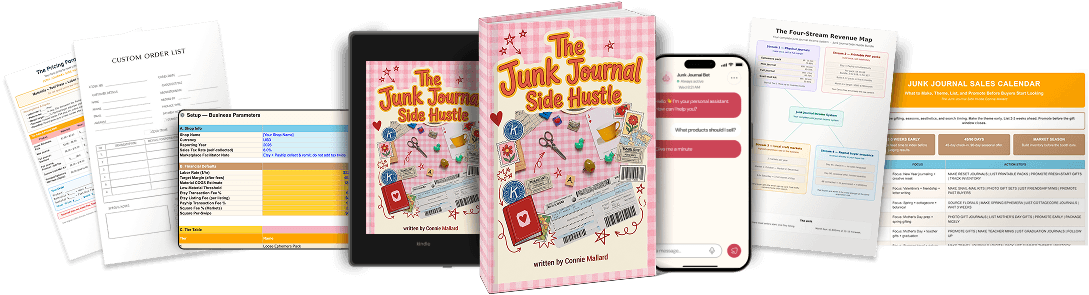
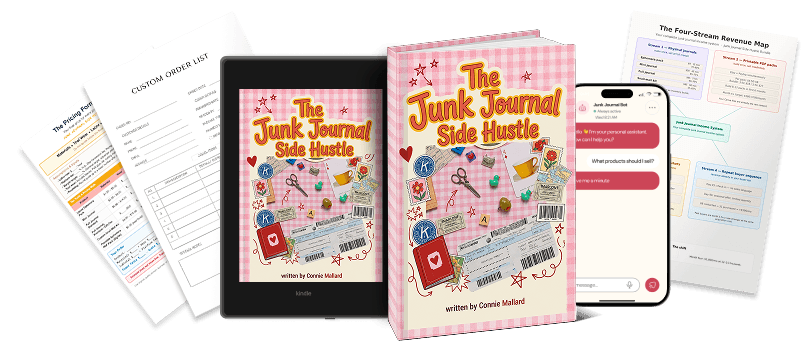
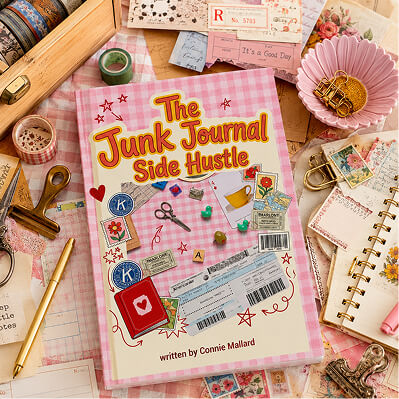
Here’s exactly what comes with The Junk Journal Side Hustle for $27:
The eBook
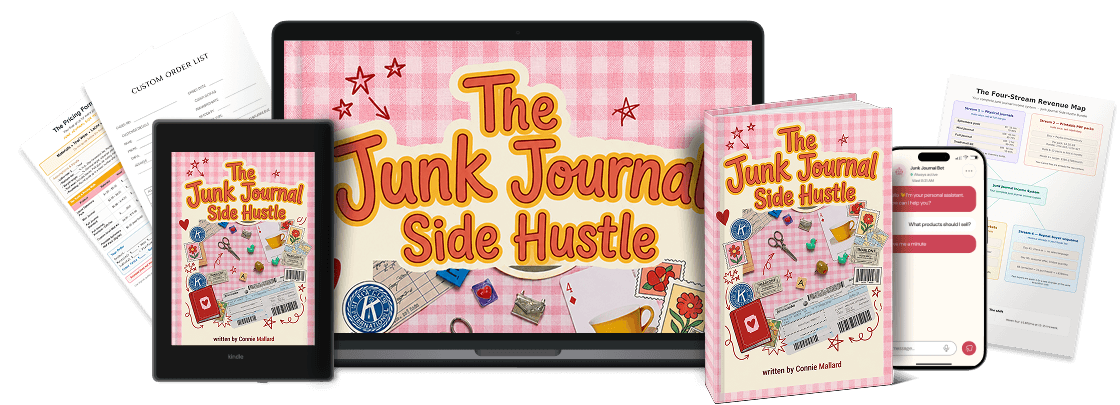
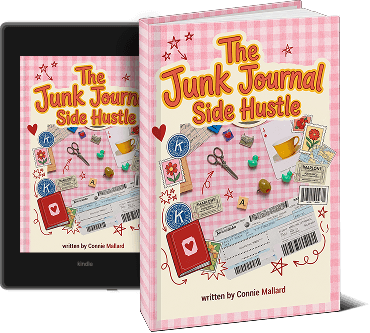
The Junk Journal Side Hustle: 100 pages covering the complete system from product selection through repeat-buyer email sequences. Pricing math, four-tier product structure, Etsy SEO, photography, customer follow-up, printable PDF income, local craft markets, and the business basics. Every chapter ends with one specific action.
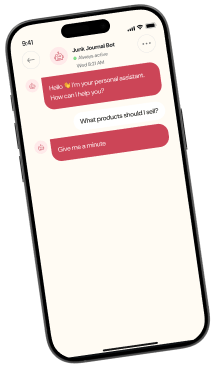
Your Personal Junk Journal Business Advisor
AI assistant trained on the four-tier pricing system in this book. When you hit a question between chapters, this is where you go.
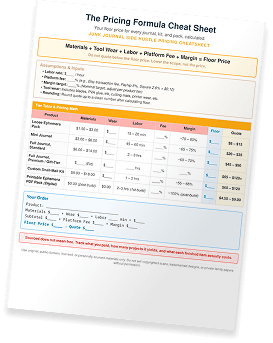
The Pricing Formula Cheat Sheet
A quick-reference pricing worksheet that helps you calculate your floor price using materials, tool wear, labor, platform fees, and profit margin so you never underquote your journals.
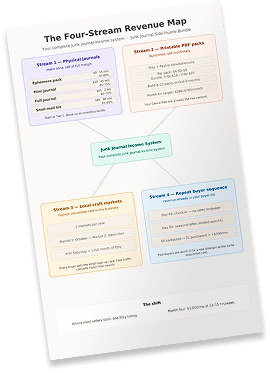
The Four-Stream Revenue Mind Map
A one-page visual of your complete income system with all four revenue streams laid out together.
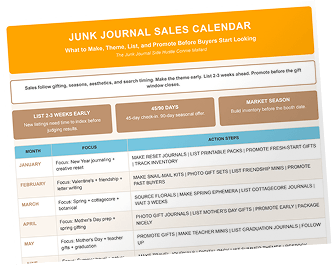
The Seasonal Sales Calendar
Which products to push each month, with the October through December holiday window mapped out in full.
30-day money-back guarantee: if the pricing formula doesn't pay for the book on your next order, I'll refund it. No questions.
You Already Know How to Make the Journal
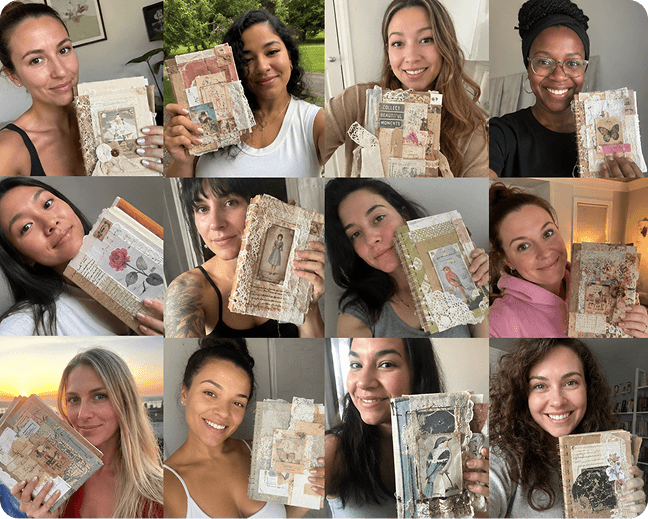
If finished journals are stacking up on the spare-room shelf and the only buyers you’ve had are coworkers and one neighbor, you already have everything the craft side requires.
- Full-size junk journals
- Mini journals
- Loose ephemera packs
- Snail-mail kits
- Printable PDF packs
Those four physical tiers and the digital layer are the structure this book walks you through. What you don’t have yet is the system around the work you already know how to do.
The $210 Saturday
October 2019. I borrowed a folding table from my neighbor and covered it with a piece of linen from my mother’s cedar chest. I had eight journals and a handwritten sign on cardstock. I had priced everything in Sharpie the night before, second-guessing every number.

In four hours, I sold five. Five out of eight. Strangers with no connection to me and no obligation to be kind.
I drove home on I-26 talking out loud the whole way. Not celebrating. Calculating. Five out of eight. If I had twelve, maybe I sell seven. If the prices were higher, maybe I still sell five. That is the moment something becomes real. It doesn’t feel like a party. It feels like a math problem you suddenly want to solve.
That table changed what I thought was possible. Not because $210 is life-changing money. Because a stranger had decided that something I made from cereal boxes and old magazines was worth $42.
Three Places This Business Leaks Money
The craft layer is over-covered. There are thousands of YouTube tutorials on binding, layering, distressing. The business layer is what no one teaches.
- The first leak is pricing by comparison.
You open Etsy, find the cheapest listing that looks like yours, list ten dollars below it to be competitive, and tell every future buyer your work is worth less than someone else’s. I did this for eight months. It cost me about $3,000 in revenue I gave away permanently.
- The second leak is the saturation story you’ve been telling yourself.
You searched “vintage junk journal” on Etsy, saw thousands of results, and decided the market is full. Here is the honest truth. That market is not full. It is badly listed. Look at the first three pages of results closely. Count the blurry photographs. Count the titles no real buyer would ever search for. Count the listings that haven’t sold in months. The real competition is not thousands of listings. It’s the handful on each page actually doing the work.
- The third leak is staying on Etsy alone.
Two listings, no PDF layer, no local market, no email list. Income disappears the month your listings drop in search. The maker who builds four physical tiers and a digital PDF library has more than one way for a buyer to enter the shop.
The person who ran that session in the creative business group named the customer-list version of this in one sentence: “That is not a customer list. That is a list of people who already trust you and have not heard from you since the day you took their money.” That sentence is worth the price of any program.
What the Book Walks You Through
This book is the Junk Journal Side Hustle Operating System. Nine pieces, in order: pricing logic, material sourcing, four-tier product structure, Etsy SEO, photography, repeat-buyer sequences, printable PDF packs, local craft markets, and the business basics. Each piece builds on the one before it. That sequence is how the business moves from a folding table with eight journals toward a more stable monthly shop system.
- Pricing that defends a real floor.
Materials plus time plus overhead plus margin equals a number you do not go under. Chapter 3 walks through the math for each tier and gives you the floor for ephemera packs, mini journals, full journals, and snail-mail kits.
- Etsy listings that buyers can actually find.
The three-part title formula. The thirteen-tag strategy. The two-to-three-week indexing rule most first-time sellers break and lose their ranking for. Chapter 4 covers all of it.
- Batch photography that ends the listing bottleneck.
One session, six journals, three packs, two kits, photographed together instead of one listing at a time. Chapter 5 walks through the 45-minute first setup and the consistent shots that follow.
- A repeat-buyer sequence you can turn into a simple weekly habit.
The 45-day check-in. The 90-day offer. Chapter 6 gives you both message templates and the math on what they actually produce.
- A digital layer that sells while you sleep.
Printable ephemera PDFs priced around $6.50 each, listed on Etsy and Payhip. Chapter 7 shows you how to build a library of eight to twelve packs from materials you already have.
30-day money-back guarantee: if the pricing formula doesn't pay for the book on your next order, I'll refund it. No questions.
What I Can Help You Build Toward

The framework built in this system can open up the possibility of an extra $2,200 in revenue, working about 15 hours a week.
Three revenue streams: Etsy physical journals, digital PDFs on Etsy and Payhip, and a small
number of local craft markets each year. No team. No paid ads. No real Instagram presence.
That’s the steady state. It is not month one.
The target for a maker who already knows the craft is the possibility of an extra $1,800, working 12 to 15 hours a week. Some makers build toward it sooner. Some take longer. A few never get there because they skip the chapters on photography or pricing. Those chapters are not optional.
Building this system takes focused execution, not overnight tricks. That’s not what you want to hear. It is the honest version.
The $3,000 I Gave Away
Most makers leave time out of their math. They count the paper and the glue. They forget the 45 minutes of sourcing, the hour of binding, the 20 minutes of design layout, the 10 minutes of packaging.
The formula in the book is:
Materials + Time + Overhead + Margin = Price
loose ephemera pack
$9
mini journal
$28
full-size junk journal
$65
snail-mail kit
$85
The formula stays the same. The numbers change by tier. The first time you run it, it feels slower than guessing. After that, it gives you a price you can list without apologizing for it.
30-day money-back guarantee: if the pricing formula doesn't pay for the book on your next order, I'll refund it. No questions.
The Photography Session That Stops Killing Your Listings
Photography is where most Etsy attempts die. Not because the maker isn’t good at it. Because she sets up a session every time she wants to list one item, and that turns the listing into a Saturday afternoon project. So she stops listing.
The fix is one session, batched.
- Window light
- Foam board on a small table
- Phone on a small tripod above it
- Six journals
- Three ephemera packs
- Two snail-mail kits
Photographed in 90 minutes.
Once the setup is consistent, listing is a 20-minute administrative task. Without batching, every new product becomes a reason to put off Etsy. With it, the bottleneck disappears.
Chapter 5 walks through the 45-minute first setup and the consistent shots that follow. The foam board you already bought and never opened will finally earn its keep.
I Have Buyers, Not Followers
I want to be clear about what this book does not teach.
It does not teach you to become an influencer. It does not teach you to grow a following or build a brand presence. I have buyers, not followers. I run a shop, not a brand. Social media followers are not the foundation of this business. The four hundred who have bought from me are.
The repeat-buyer sequence in Chapter 6 is the closest thing to a shortcut this book contains, and it isn’t a shortcut. It’s a 15-minute habit.
A buyer who already owns one of your journals is worth three to five times more to your shop than a brand-new stranger at the same acquisition cost. She has already inspected your quality. She knows how you pack. She remembers the small handwritten note in the box. The only thing standing between her and a second order is a reminder that you exist.
Most makers never send that reminder. I had four hundred who were waiting for one and didn’t know it.
30-day money-back guarantee: if the pricing formula doesn't pay for the book on your next order, I'll refund it. No questions.
A Saturday at the Right Market Can Match a Full Month of Etsy
The highest per-hour income I make in this business does not happen on Etsy. It happens at a folding table on a Saturday morning in October.
Two markets a year is enough. One in the fall, when foot traffic builds before the holidays. One holiday market in December. That is the entire market schedule for Hollow Branch Paper Co.
Six hours of foot traffic at the right market can match a full month of Etsy income. Not because the per-item price is higher. Because the conversion rate is. The buyer who picks up a journal in person and turns it over in her hands does not need three weeks of search ranking to decide. She decides right there.
Chapter 8 covers what a booth actually costs, what to bring, how to set up the table, and how to use the email sign-up sheet to bring market buyers back online.
30-day money-back guarantee: if the pricing formula doesn't pay for the book on your next order, I'll refund it. No questions.
Why $27
Because this information used to sit inside a course with 40 hours of recordings and no clear order to work through them in.
This book is the order. Every chapter is a decision you make before the next one makes sense.
Read it through for the first time. Then use it as a reference.
The journals on the spare-room shelf are not earning anything. The buyers exist. The price floor is calculable. The system is designed to fit in 12 to 15 hours a week.
30-day money-back guarantee: if the pricing formula doesn't pay for the book on your next order, I'll refund it. No questions.
Inside the Book You'll Learn:
- Why pricing by comparison costs you more than any other mistake in this niche
- How to source materials for almost nothing from five reliable channels
- The four-tier product structure that turns a one-product shop into a real business
- How to write Etsy titles around the words buyers actually search
- Why your first three weeks on a new listing should look quiet, and what to do instead of changing it
- The 45-minute batch photography setup that runs from one corner of one room
- The two-message follow-up sequence that brings buyers back without sounding salesy
- How to build a library of printable PDF packs that sell while you sleep
- What a craft market booth actually costs and what to bring to break even on the first one
- How to think about sales tax, Schedule C basics, and when to ask a professional
That last part is not legal or tax advice. I am not your CPA or attorney. I cover the basics in plain English because skipping that layer can cost you later.
30-day money-back guarantee: if the pricing formula doesn't pay for the book on your next order, I'll refund it. No questions.
The Drawers Are Already Full
You don’t need another washi tape set. You don’t need to watch another YouTube tutorial on binding. You don’t need to clean up the studio one more time before you can list anything.
The materials are already in the drawers. The journals are already on the shelf. The skill is already in your hands.
If six more months pass, the same drawers will be a little fuller. The same two listings will still be sitting on Etsy unsold. The same coworkers will still be asking for one for their sister-in-law and getting it for free.
The difference is whether you have a price ready when they ask.
30-day money-back guarantee: if the pricing formula doesn't pay for the book on your next order, I'll refund it. No questions.
Earnings note: The potential $2,200 figure mentioned is my own result at Hollow Branch Paper Co. after the system was built. It is not a guarantee. Your results depend on your products, pricing, consistency, market, time, and follow-through.
1 Your Info
Your Order Info
2. payment
Your Payment Details
You’ll get an order confirmation and download link by email.
What’s Included
- The Junk Journal Side Hustle eBook
- Your Personal Junk Journal Business Advisor
- The Pricing Formula Cheat Sheet
- The Four-Stream Revenue Mind Map
- The Seasonal Sales Calendar