
How I make $1,800 a month selling handmade paper goods online, and how you can build toward the same kind of side income in 4 months
Without quitting your job, buying ads, chasing followers, or learning to act cheerful on video
A simple, step-by-step business guide for the woman who already knows the craft and is ready to stop giving their work away.

My name is
Connie Mallard
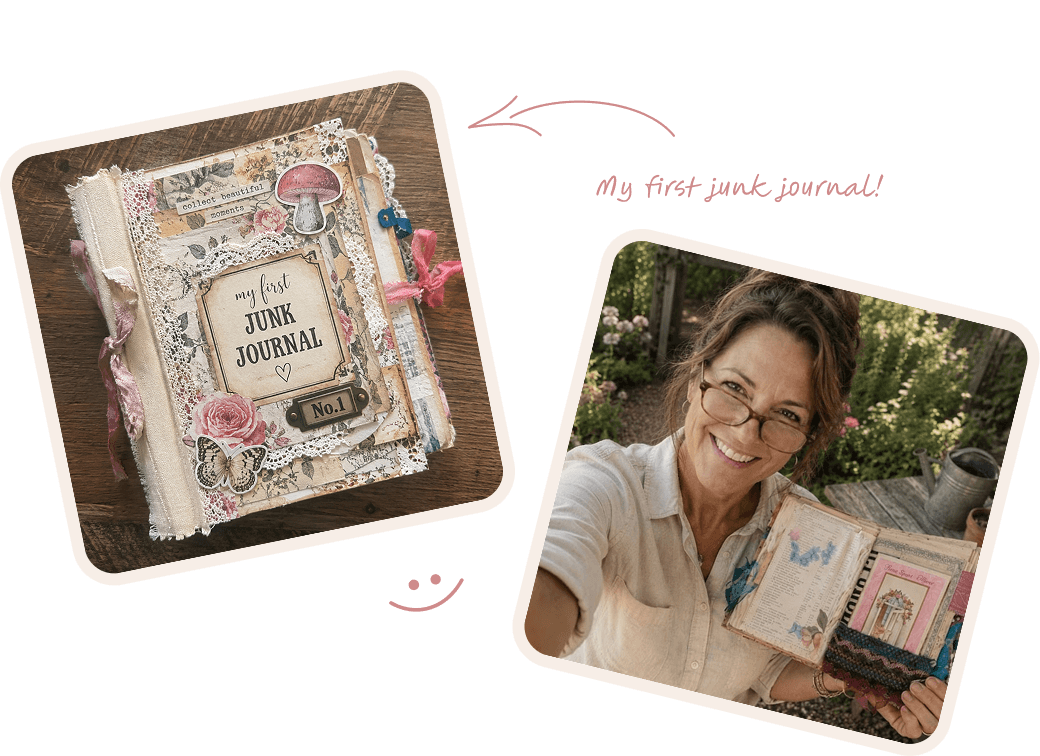
I make and sell junk journals.
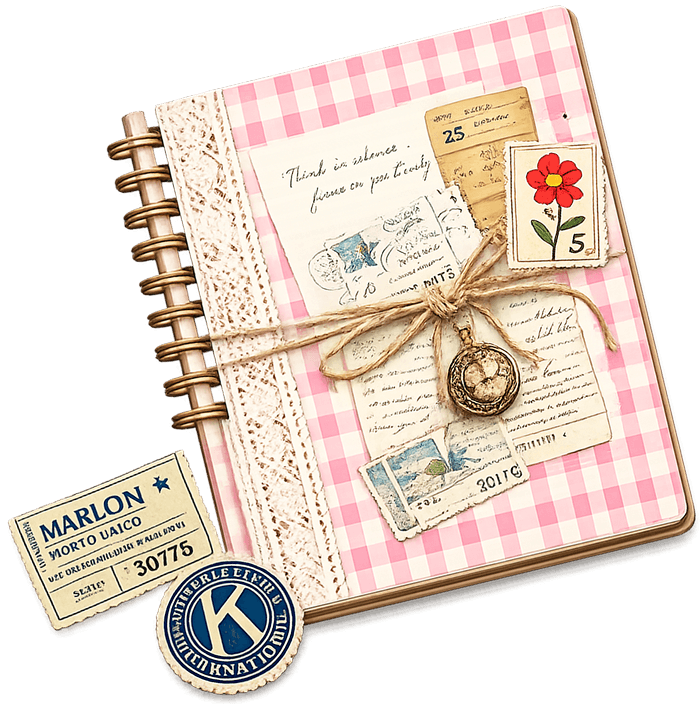
If that phrase is new to you, a junk journal is a handmade, heavily decorated scrapbook made from old paper, book pages, fabric scraps, lace, envelopes, receipts, recipe cards, sheet music, and the kind of little bits most people throw away.
Some people use them as memory books. Some use them as art journals. Some give them as gifts. And some makers also sell the digital printables used to make them, like tags, labels, journal cards, faux receipts, and vintage-style paper packs.
That last part matters.
Because the money is not only in the finished journal. It can also be in the paper pieces that help other women make their own. I learned that late. Cost me plenty.
I started with 3 cardboard boxes and a bad Tuesday night
In 2019, my daughter left for college. My marriage ended 6 months later.
Not loud.
Not dramatic.
Just quiet and done.
Then I was alone in the house with 3 cardboard boxes from my mother’s estate. Old Life magazines. Handwritten recipe cards. Sheet music my grandmother had marked in pencil. Church bulletins from 1967.
I could not throw them away. I also had no idea what to do with them.
One Tuesday night, around 11 p.m., I found junk journaling on Pinterest. I made my first journal from a cereal box, a rubber band, and some of those old papers. Took about 2 hours. Then I cried. A little.
I still don’t know if it was grief, relief, or just being tired of not making anything with my hands.
Maybe all 3.
Then came the $210 Saturday
In 2020, I took 8 journals to the Asheville City Market.
I had a folding table. A handwritten sign. No clue.

I sold 5 journals in 4 hours and made $210.
I drove home talking out loud to myself the whole way. That day did not mean I had a business.
Please hear me on that.
It meant there were buyers.
Big difference.
A business came later, after I got punched in the face by pricing, Etsy titles, bad photos, shipping math, and my own habit of discounting the second I got nervous.
That part was not cute.
I wrote this for the woman with journals in a box.
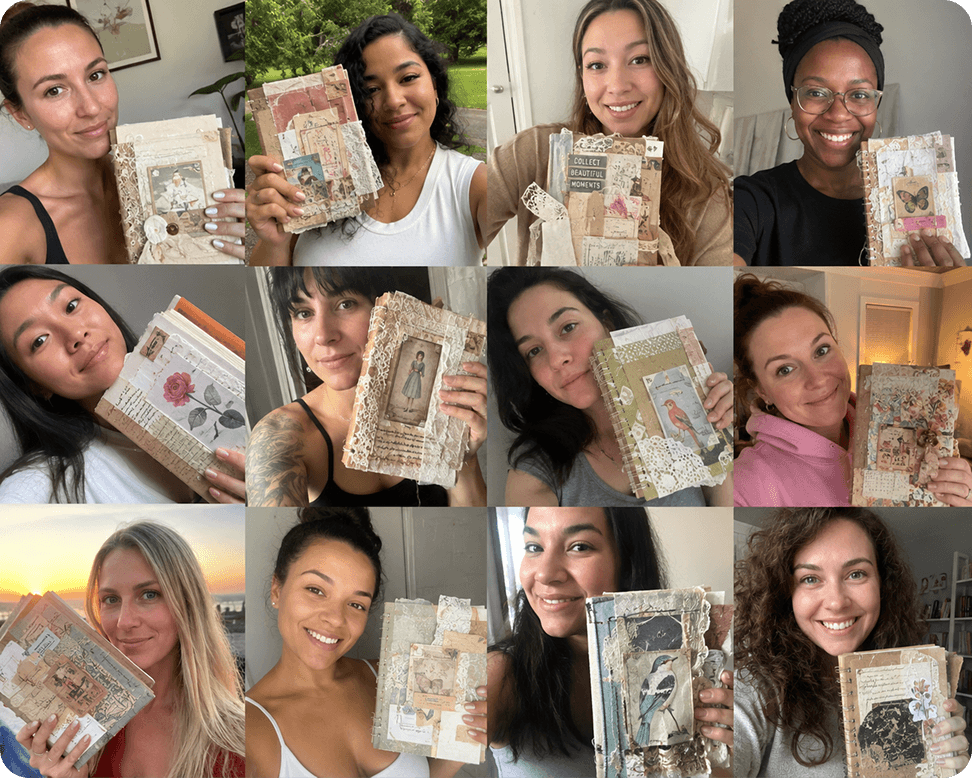
Maybe you already make junk journals.
Maybe you’ve made 30.
Maybe 60.
Maybe you don’t call them junk journals yet, but you’ve been making handmade scrapbooks from old paper, fabric, photos, envelopes, and thrifted bits for years.
You know how to make the thing. That’s not the problem.
The problem starts after the journal is done. What do you charge? Where do you sell it? How do you photograph it? What do you write in the Etsy title? What are tags supposed to do? How do you ship without losing money?
And the mean little question under all of it:
Who am I to charge real money for this?
I know that question. I let it run my shop for 8 months. Bad idea.
The goal:
$1,800/Month
within 4 months
That number is not magic. It is math.
The plan in this book is built around 3 income streams: Finished handmade journals. Smaller paper goods and kits. Digital printable packs.
The month-four target is $1,800 a month, working about 12 to 15 hours a week. Not week one. Not from 2 listings. Not by tossing a journal on Etsy and waiting for strangers to bless you. You will source materials. Make products. Take photos. Write listings. Fix what does not sell. Answer buyers. Ship orders. Do the slow parts. That is the deal.
But if you’ve already been making journals for free, or selling them for less than they’re worth, this book gives that work a place to go.
Most tutorials stop too early
- YouTube will show you how to make a pocket.
- Facebook groups will tell you your journal is lovely.
- Pinterest will make you want to buy 11 more rolls of washi tape and some tiny brass scissors you do not need.
Ask me how I know. But most of those places stop right before the part that matters for income. They stop when the journal is finished. That is where this book starts.
Because the hard question is not, “Can I make another journal?”
You can.
The hard question is, “Can I sell this one for what it is worth?”
Yes.
But not by guessing.
The first thing I had to fix was pricing
I used to price by fear.
I’d open Etsy. Find the cheapest journal that looked sort of like mine. Then I’d go lower. I told myself I was being fair. I was not.
I was teaching buyers that my work was worth less than someone else’s.
A $30 handmade journal sounds kind. It can also sound flimsy. A $65 journal needs proof.
- Good photos
- Clear size
- Page count
- Materials
- What it can be used for
- How it feels in the hand. What kind of buyer it is for
That is the part most makers skip.
Then they wonder why people don’t buy.
Cheap can hurt you
Let’s do the ugly math.
You sell a journal for
$28
Your supplies cost
$8
Packaging costs
$2
Etsy takes fees. Shipping takes time. The journal took 4 hours. You did not make money. You made a donation with lace on it.
I say that with love.
I did it too.
My worst stretch of underpricing cost me around $3,000. I know because I went back and counted.
I do not recommend that little exercise unless you enjoy feeling like you swallowed a stapler.
The market is not full
I hear this all the time.
“Connie, Etsy is too crowded.”
- Dark photos.
- Vague titles.
- No page count.
- No size.
- No gift use.
- No clear theme.
- No shipping details.
- Descriptions that say, “Handmade junk journal, vintage style,” and then just stop.
A buyer cannot buy what she does not understand.
She may like the cover. She may even favorite the listing. But if she has to guess how big it is, what is inside, or whether it will hold up as a gift, she leaves.
Busy buyers do that.
Your job is to make the yes feel safe.
A buyer is not buying old paper
She is buying a feeling.
- A recipe journal that reminds her of her grandmother’s kitchen.
- A garden journal for her mother.
- A grief journal for the sister nobody knows how to talk to yet.
- A travel journal that feels like it already has a history.
- A place to keep birthday cards, ticket stubs, prayers, notes, photos, and all the tiny paper scraps that prove a life happened.
That is why the listing matters.
The journal may already carry the feeling.
But the buyer can’t hold it through a screen.
Your photos and words have to do that job
The first photo setup took me 45 minutes
I wish I could tell you it took 5.
It did not.
I moved the journal 14 times. I fought a shadow from my own hand. I used the wrong table first. Then the wrong cloth.
Then Biscuit, my cat, sat directly on the open page spread like he had been hired for quality control.

Normal day. But after I got the setup right, it got easier.
Window light. A flat surface. A few shots that answer buyer questions.
- Cover
- Spine
- Open pages
- Pocket detail
- Thickness
- Scale
- Gift-ready packaging
Your first setup will take longer than you want.
Do it anyway.
Etsy titles do not need to sound like a junk drawer
Please do not write this:

Junk Journal Handmade Vintage Boho Ephemera Lace Cottagecore Scrapbook Diary Gift Memory Keeper Botanical
That is not a title.
That is a craft store aisle after a small tornado.
Buyers search in plain words.
“Botanical junk journal gift.”
“Handmade recipe journal.”
“Vintage garden journal.”
“Printable ephemera pack.”
“Christmas junk journal kit.”
You need search words.
Yes.
But the title still has to make sense to a human woman with a credit card in her hand and 4 minutes before dinner needs checking.
Printables changed my shop
This part embarrassed me.
For months, I tucked digital ephemera files into my physical journal orders as little free gifts.
Buyers liked them.
Some mentioned them in reviews.
And I kept giving them away.
Then I finally listed them as separate digital packs.
$4.50
$7
$9
Nothing wild.
Within 60 days, those files added $680 a month.
Without making another full journal.
Now, digital printables are not lazy money.
I hate when people sell it that way.
You still have to make the files, name them, show them, list them, and improve the listing when it sits there doing nothing.
But once a printable pack is made, it can sell more than once.
That changes the math.
This book gives you the shop part
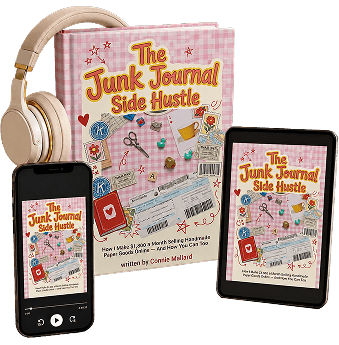
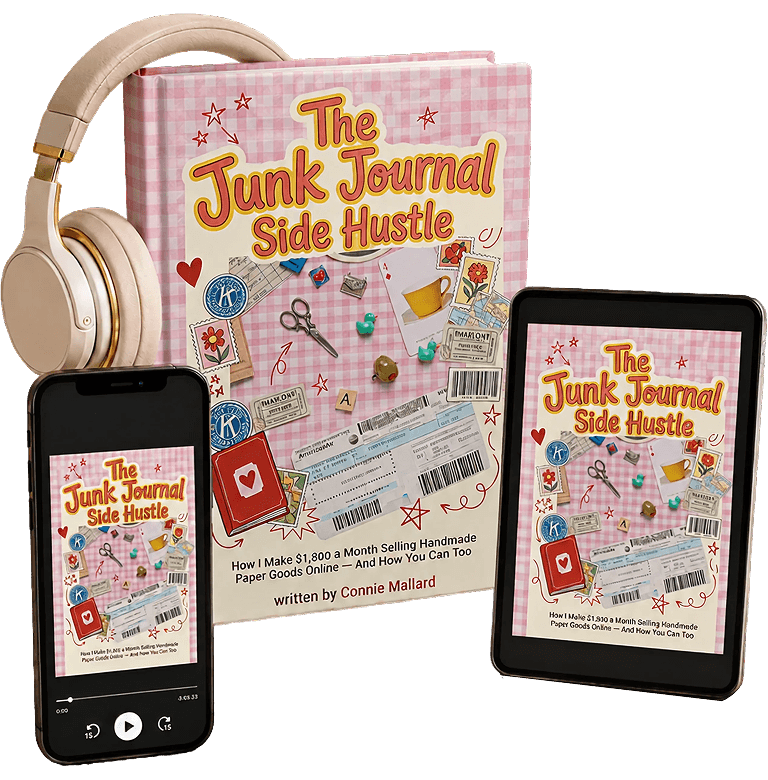
The Junk Journal Side Hustle is the book I wish I had before I opened my Etsy shop in November 2020.
It shows you how to turn handmade junk journals and digital printables into a small paper goods business.
Plain English.
Real numbers.
No fluff.
No fake “quit your job by Friday” talk.
Inside, I walk you through:
Pricing without panic
You’ll learn how to count materials, time, fees, packaging, and profit before you pick a price.
Materials that keep your margin safe
I show you how I source estate boxes, old books, thrift finds, damaged paper, fabric scraps, and low-cost supplies without turning sourcing into a second unpaid job.
The 3 income streams
Finished journals, smaller paper goods, and digital printables. You’ll see how they work together without trying to build everything on day one.
Etsy search without the headache
You’ll learn how to write titles, tags, and descriptions so buyers can find your work and understand it fast.
Phone photos that answer buyer questions
You’ll learn how to write titles, tags, and descriptions so buyers can find your work and understand it fast.
Descriptions that sell the journal clearly
Size, page count, materials, use, gift fit, shipping, and care notes. Boring things that make money.
Printable ephemera packs
You’ll see how to turn tags, cards, labels, papers, and themed sets into digital listings.
A 30-day action plan
What to list first. What to price. What to photograph. What to leave alone until later.
That last part matters.
Because information without an order turns into another open tab.
You do not need a following
I did not have one.
I had buyers.
That is better.
Followers clap.
Buyers pay.
A small shop with clear listings beats a big social page full of people who say “so cute” and never buy.
You do not need to post every day.
You do not need to become a video person.
You do not need to turn your craft room into a stage.
If you like social media, fine.
Use it.
But this book is built for Etsy, simple customer follow-up, local sales when they make sense, and digital products that can sit in your shop doing their job.
Quiet works.
This is for you if:
You’ve made journals and given most of them away
You’ve sold a few and later knew you charged too little
You opened an Etsy shop and got stuck on photos, tags, or shipping.
You want money from the work, but you do not want your whole life taken over.
You have old paper, lace, fabric, cards, books, or family scraps sitting in boxes.
You want a clear plan more than another pep talk.
You would rather fix a listing than dance on camera.
Good.
Same.
Skip this if:
- You want fast cash
- You want to copy other sellers
- You refuse to track costs
- You want to list one journal and wait
- You think photos should take 5 minutes
- You want someone to tell you handmade selling is easy
I won’t.
It is not easy.
It is learnable.
Big difference.
This is for you if

The book is
$27
- No launch discount
- No fake timer
- No “only 47 copies left”
I don’t like that stuff.
You’ve probably spent more than $27 on glue, paper, charms, lace, or one late-night supply order you half regret.
This is the part that helps the supplies pay you back.
For $27, you get the full digital book and the audiobook companion.
Read it at your desk.
Listen while you cut paper.
Listen in the car after work.
Use the parts in order.
That is the best way.
My 30-day guarantee
- Go through the book
- Set up your listings using the method in chapter 4
- Use the pricing section
- Fix the photos
If you do not feel like you finally have a clear path to your first real sale, email me within 30 days.
- I’ll refund every cent
- No form
- No explanation required
- Fair is fair
What your next 30 days can look like
You can keep making journals for “someday.”
I did that.
Someday is a very full box.
Or you can spend the next 30 days getting the shop pieces in place.
- One priced journal
- One fixed listing
- One photo setup
- One digital printable pack planned
- One clear next step after that
No drama.
No big speech.
Just work that points somewhere.
The journals are already made
The buyers are already on Etsy searching for handmade journals, memory books, scrapbook gifts, and printable paper packs.
The gap is the business part.
- What to charge
- What to show
- What to write
- What to list next
That part I can give you in an afternoon.
The doing still belongs to you.
One more thing before you go
If you have a box of finished journals sitting in the spare room, they are already telling you something.
You did the hard creative part. Now give them a shop that makes sense.
- Price the work.
- Show it clearly.
- List it where buyers can find it.
The journals have been sitting there long enough.
1 Your Info
Your Order Info
2 Shipping
Your Delivery Address
We just ask that you cover the shipping and handling costs in order for us to send it to you. Your information is secure and will not be shared.
Helping creative women turn handmade journals, paper goods, and printables into real income—without ads, influencers, or burnout.

Explore
- About the Book
- What You'll Learn
- Meet Connie
- FAQs
Support
- Contact
- Refund Policy
- Terms & Conditions
- Privacy Policy
- Contact
- Refund Policy
- Terms & Conditions
- Privacy Policy